
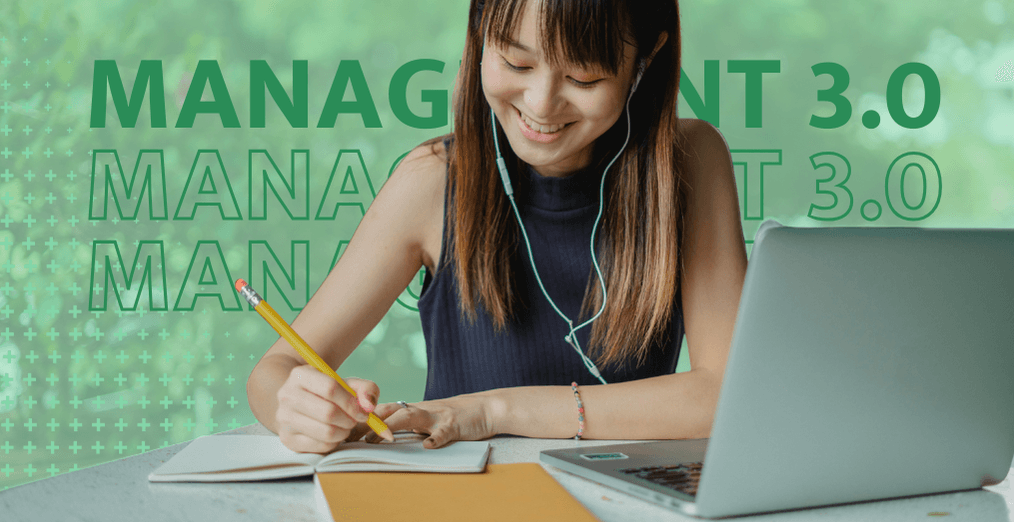


Management 3.0 is a modern management approach born from the reflections and practical experiences of managers leading teams in the world of agile transformation. It is built on a clearly defined mindset and approach to organizational management, while at the same time offering an ever-growing collection of tools, games, and practices that help every employee actively participate in this process.
The Management 3.0 Foundation Workshop is an intensive two-day experience designed to introduce participants to the agile approach to managing work and people within organizations, while also encouraging leaders to reflect on and reassess their own management attitudes through the lens of complexity thinking — the scientific foundation behind effective agile ways of working.
The workshop provides an opportunity to explore the Management 3.0 management model and experiment with practices connected to all six views of Management 3.0: Energize People, Improve Everything, Empower Teams, Develop Competence, Grow Structure, and Define Constraints. Participants work through nine learning modules aligned with the international Management 3.0 curriculum and guidelines.
Management 3.0 provides practical solutions aimed at:
- Building leadership based on effective delegation and strengthening self-organizing teams.
- Creating an environment that fosters motivation and engagement.
- Supporting learning processes and competence development at every level of the organization.
- Enabling teams and organizations to effectively deal with failure and continuous improvement.
- Supporting the scaling of organizational structures during agile transformation initiatives.
- Developing an organizational culture based on trust and transparency.
This workshop is for you if you want to consciously develop your leadership capabilities, build engaged and accountable teams and create an organization capable of continuous learning and adaptation in a rapidly changing world. Whether you are a manager, team leader, Scrum Master, Agile Coach, or someone supporting organizational development, Management 3.0 will help you see management as the process of supporting people and designing environments where teams can achieve their best results.
Prepare yourself for a highly practical workshop, a strong dose of reflection, and a wide range of concrete tools and practices that you will be able to apply immediately in your everyday work. Because effective management today is no longer about controlling people — it is about creating the conditions in which people and organizations can grow, collaborate, and achieve sustainable results.
Information about the mandatory add-on
Participation in the workshop requires the purchase of the Certified Management 3.0 Foundation Workshop Attendee certificate.
Participants must complete an evaluation survey provided by Management 3.0 B.V. to receive the certificate. After the workshop, each participant will receive a personalised link to the survey. The certificate will be sent by email once the survey has been completed.
Purpose of the training
Objectives referring both to the knowledge acquired during the training and its practical application.
- Increased understanding of the Management 3.0 approach – a modern management concept tailored to agile work environments (Modules: Management and Leadership, Management 3.0 Principles).
- Enhanced knowledge of the scientific foundations behind the effectiveness of agile approaches to managing work and people (Module: Complexity Thinking).
- Improved knowledge and skills in creating a work environment that supports intrinsic motivation (Module: Motivation and Engagement; Practices: Moving Motivators, Big Value List, KUDO Cards, 360 Dinner).
- Enhanced knowledge and skills related to developing and applying empowerment practices within an organization (Module: Delegation and Empowerment; Practices: Delegation Poker, Delegation Board).
- Improved knowledge and skills in identifying and shaping organizational culture (Module: Values and Culture; Practices: Culture Books, Values Stories).
- Enhanced knowledge and competencies in supporting continuous learning and skill development (Module: Learning and Competence; Practices: Team Competency Matrix, Exploration Days).
- Improved ability to consciously design and evolve organizational structure (Module: Scaling Organizational Structure; Practice: Meddlers Game).
- Enhanced understanding and capability in foundational change management practices (Module: Change Management; Practices: Moving Motivators, Kudo Cards, Feedback Wrap, Celebration Grid, Merit Money, Change Management Game).
Target group
- People managers across all types of work environments – particularly those working in agile settings or organizations undergoing agile transformation
- Team leaders, Project Managers, Scrum Masters
- Professionals responsible for fostering collaboration, designing development programs, and shaping organizational culture
- HR and L&D departments
- Individuals involved in implementing agile within their organizations
- Team members working in agile environments who are facing challenges related to self-organization
- Educators, academic instructors, and trainers
Benefits
- You will understand how to create a work environment that supports team self-organization, strengthens accountability, and fosters sustainable intrinsic motivation among employees.
- You will learn how to assess the current situation of your team and organization in order to consciously choose actions that support people development, collaboration, and effectiveness.
- You will gain practical skills in planning, applying, and implementing proven Management 3.0 tools and practices to build effective agile teams and organizations.
- You will discover how to flexibly adapt Management 3.0 practices and management approaches to the real needs of your team and the specific context of your organization.
- You will develop a deeper understanding of the differences between traditional management approaches and agile management based on trust, shared responsibility, and working with the system rather than controlling people.
- You will have the opportunity to exchange experiences with other participants and validate your current ways of working in the context of systems thinking, team psychology, and modern management concepts.
- You will explore and practice Management 3.0 tools and games that will help you support team development, lead change initiatives, and build a collaborative organizational culture.
Exam and certification
The Management 3.0 Foundation Workshop Attendee certificate confirms participation in the workshop and enables participants to apply for the Management 3.0 Facilitator licence. For more details, please visit: https://management30.com/facilitators/licensing/.
Training programme
MODULE 1 – MANAGEMENT AND LEADERSHIP
- Understanding the difference between management and leadership — who is a Leader and who is a Manager in the world of Management 3.0?
- What distinguishes Management 1.0 and 2.0 from Management 3.0? What behaviors and characteristics define each approach? What management style dominates in my organization, and how do I work as a manager?
MODULE 2 – MANAGEMENT 3.0 PRINCIPLES
- Is Management 3.0 a set of practical tools and techniques, or a mindset for modern management?
- The five principles of Management 3.0 and how they translate into everyday leadership practices.
MODULE 3 – COMPLEXITY THINKING
- Complexity thinking versus linear thinking in a VUCA and BANI world.
- Jurgen Appelo’s Systems Model — what does it mean that our teams are social, complex, and adaptive systems?
- Eight complexity thinking guidelines for Leaders and Managers.
- Mindful Sensemaking — supporting leadership decision-making depending on the nature of the situation.
MODULE 4 – DELEGATION AND EMPOWERMENT
(Practice: Delegation Poker, Delegation Board)
- Delegation challenges — what are self-organizing teams, and why should organizations strive toward them? Who should be responsible for decision-making within the system?
- Delegation as a competency versus delegation as a process — the seven levels of delegation in Management 3.0.
- Appelo’s new leadership styles model — empowering responsibility and rethinking leadership approaches.
MODULE 5 – MOTIVATION AND ENGAGEMENT
(Practice: Moving Motivators, Happiness Door)
- What motivates us at work? Understanding the difference between intrinsic and extrinsic motivation and the characteristics of motivating work environments.
- The CHAMPFROGS model — ten human motivators in professional and personal life, their hierarchy, and their impact on how managers work with teams.
MODULE 6 – CULTURE AND VALUES
(Practice: Values Stories, Culture Book)
- Building constraints (rules, values, principles) — the role of organizational culture in agile management. Is our culture real, or does it only exist on posters and company websites?
- How leaders shape organizational culture — defining behavioral guidelines, transparency of rules, and boundaries that clarify what is and is not acceptable.
- Practices supporting culture development — how to use the Values List, Culture Book, Value Stories, and Values Day.
MODULE 7 – LEARNING AND COMPETENCE
(Practice: Team Competency Matrix, Exploration Days)
- What are competencies? What does it mean to do something effectively and well?
- The Team Competency Model — five levels of working with development, from defining competency structures to creating constructive tension for growth.
- Working with the Team Competency Matrix to identify and develop team capabilities.
MODULE 8 – SCALING ORGANIZATIONAL STRUCTURE
(Practice: Meddlers Game)
- Does an ideal organizational structure exist? What does it mean to build a network versus a hierarchy?
- Eleven approaches supporting organizational balancing — how to apply them in leadership practice.
MODULE 9 – CHANGE MANAGEMENT
(Practice: Change Management Game, Celebration Grid, Feedback Wrap, Kudo Cards)
- Change management as a constant and critical leadership competency. Building a mindset of continuous improvement. Starting with “Why?”
- The Management 3.0 Change Management Model — designing and implementing change through four perspectives: Dance with the System, Think about People, Empower the Network, and Change the Environment.